
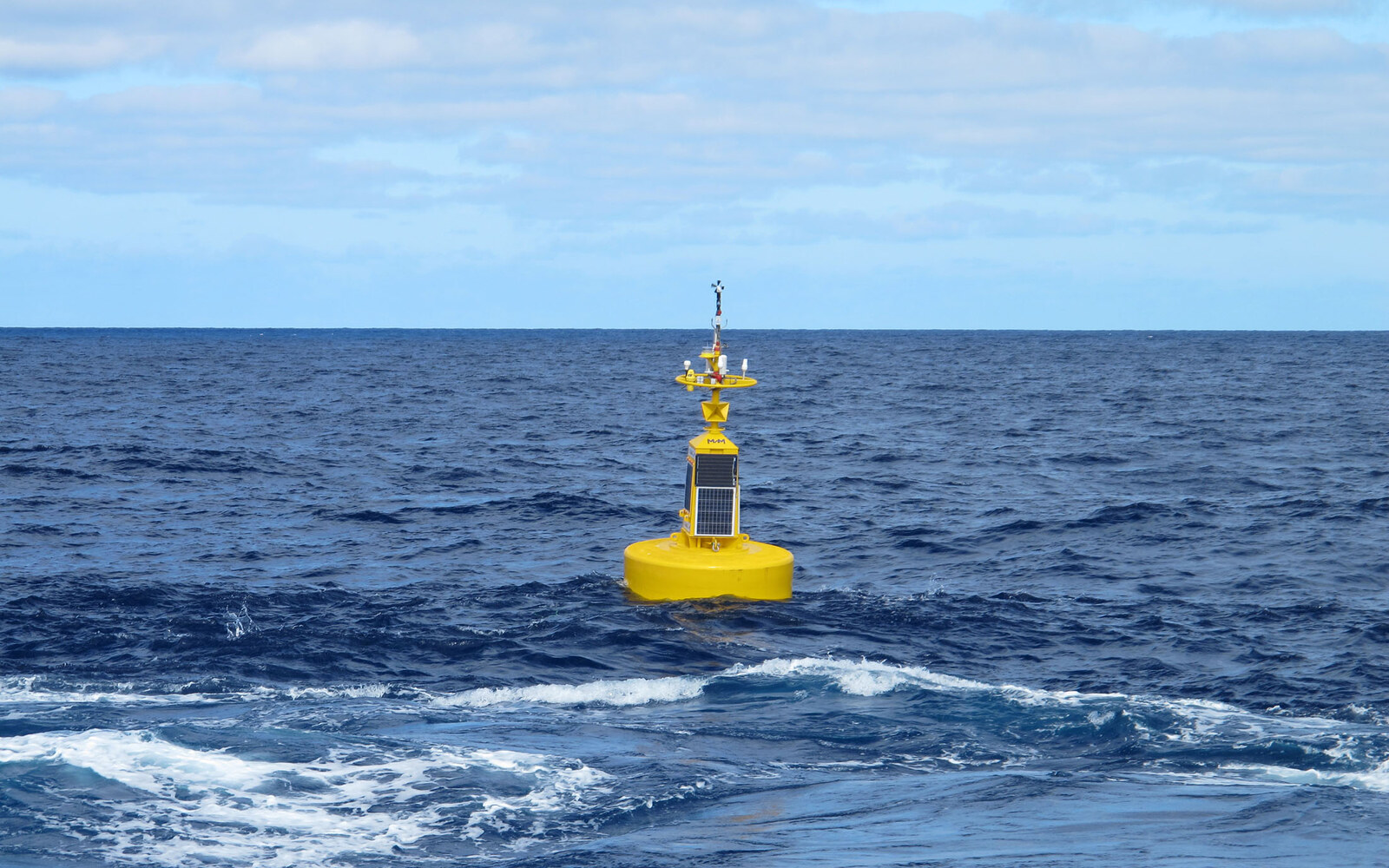
ESTOC, the European Station for Time-Series in the Ocean at the Canary Islands, is located about 60 nautical miles north of Gran Canaria, near 29°10′ N, 15°30′ W, over a seabed approximately 3,610 m deep. PLOCAN designs, deploys and maintains the buoy; QUIMA at ULPGC provides biogeochemical scientific leadership and advice; IEO-CSIC contributes physical-oceanography support and vessel time for mooring, maintenance and sampling campaigns.
Two independent surface systems, System 105 and System 106, measure air temperature, relative humidity, atmospheric pressure, wind speed and direction, compass heading and photosynthetically active radiation. Both include redundant sensors for sea-surface temperature, conductivity/salinity, dissolved oxygen, chlorophyll and turbidity. Marine carbon observations use pH and pCO₂ sensors in a non-redundant configuration.
The observation infrastructure has operated since 1995, with changes in instrumentation over time. ESTOC joined ICOS in 2023 and is undergoing labelling as a Class 1 ocean station, with completion expected in 2027. In 2024, mooring and maintenance operations were supported by the research vessel Sarmiento de Gamboa.
The station supports studies of the marine carbon cycle, ocean acidification and long-term oceanographic variability in the subtropical Northeast Atlantic. Its fixed-point time series complement the ship-based spatial observations of CanOA and help assess the ocean’s role in carbon uptake. The station website provides further information on the observation infrastructure.