
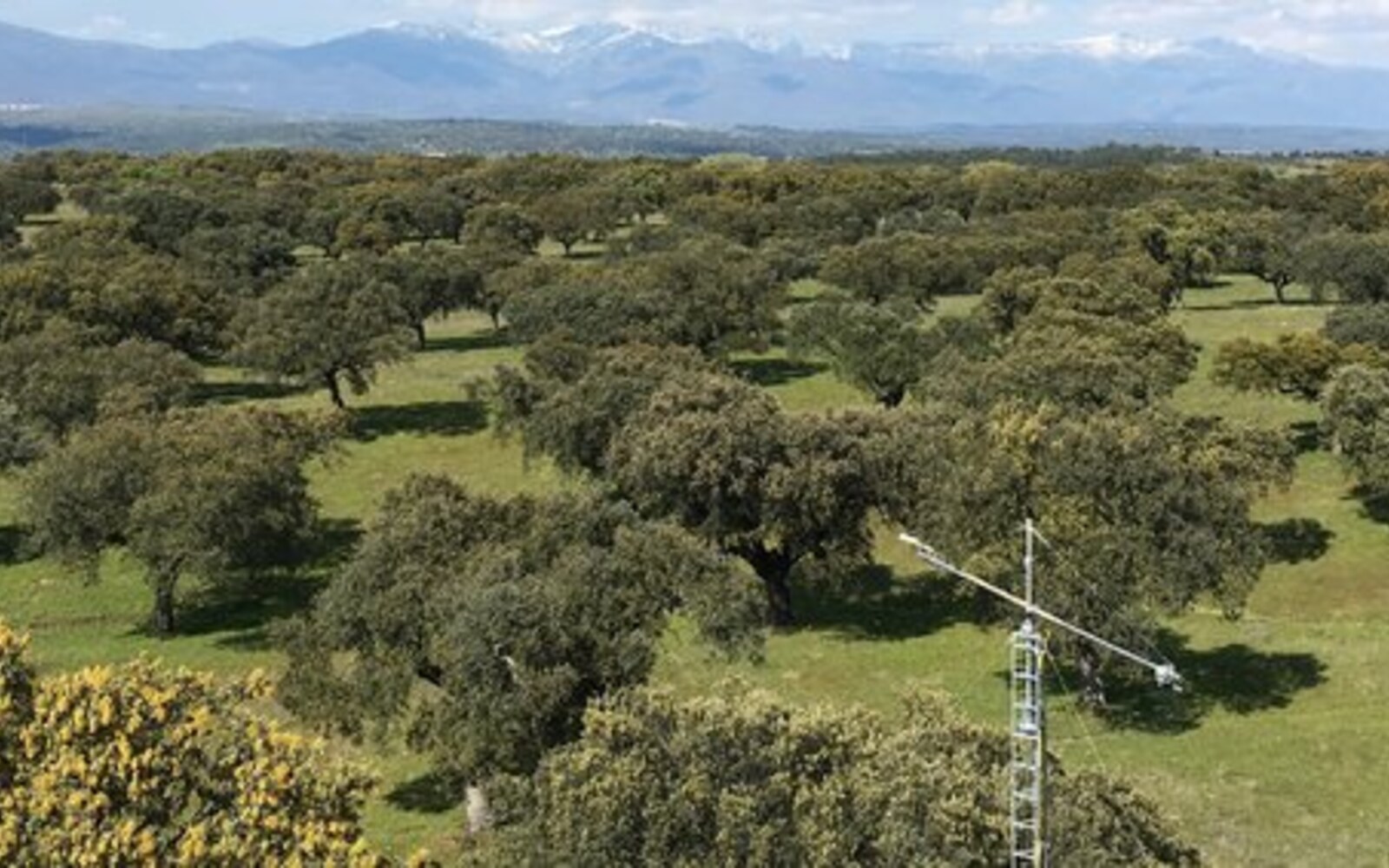
Majadas de Tiétar is located in Cáceres, Extremadura, in a Mediterranean dehesa: an open holm-oak woodland with a herbaceous understory managed as an agrosilvopastoral system. The trees are approximately 100 years old, with around 20% canopy cover and about 22 trees per hectare. The Mediterranean Center for Environmental Studies (CEAM) operates the station; SpecLab-CSIC provides complementary remote-sensing observations.
Eddy covariance measurements quantify exchanges of CO₂, water vapour and energy between the ecosystem and the atmosphere. Auxiliary instrumentation measures meteorological, soil and vegetation variables, helping interpret the drivers of the fluxes. SpecLab-CSIC combines field, airborne and satellite observations to characterise the ecosystem and connect local measurements with larger spatial scales.
The experimental station began observations in 2003. Majadas de Tiétar was labelled as an ICOS Associated ecosystem station on 15 November 2023. Its official ICOS data series begins on 1 January 2020 and is available through the ICOS Carbon Portal. The historical observation programme and the period covered by ICOS products are therefore distinguished.
The station supports studies of carbon and water exchanges, seasonal ecosystem functioning and responses to climate variability in Mediterranean dehesas. Its flux and remote-sensing observations help develop and evaluate ecosystem models and satellite products. Together with Aguamarga, it provides complementary observations of Mediterranean ecosystems with contrasting vegetation and water availability.