
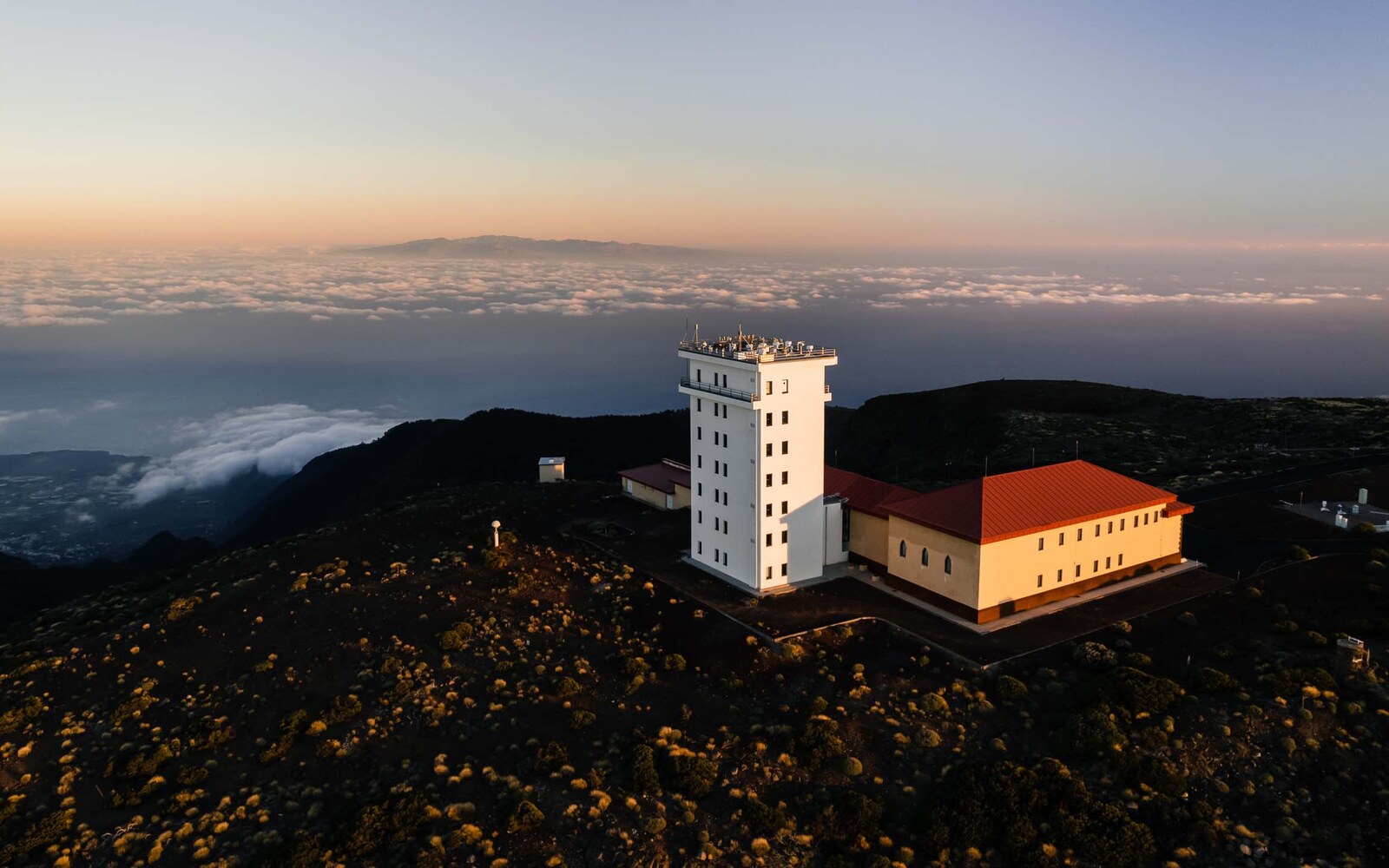
Izaña is located at the Izaña Observatory in Tenerife, at 2,373 m above sea level, and is operated by the Izaña Atmospheric Research Center – Emilio Cuevas (IARC), part of the Spanish State Meteorological Agency (AEMET). The site is usually above the subtropical temperature inversion that characterises the region and is also within the subtropical subsidence regime associated with the descending branch of the Hadley cell. For these reasons, the station provides observations representative of the free troposphere, closely reflecting large-scale trends in many atmospheric constituents.
The observatory opened in 1916 and, since the 1970s–1980s, has hosted a wide range of atmospheric composition measurement programmes covering many areas, including greenhouse gases, reactive gases, aerosols, ozone and different remote-sensing techniques, eventually becoming an international reference site in the field and a Global Station of the World Meteorological Organization (WMO) Global Atmosphere Watch (GAW) programme.
Its historical CO₂ and CH₄ series began in 1984, followed by N₂O in 2007 and CO in 2008. These long-term measurements are currently carried out within the GAW programme. Dedicated ICOS measurements began on 2 November 2022, using instrumentation fully independent of the historical GAW instrumentation, which continues to operate in parallel at the observatory. Izaña was labelled as an ICOS Class 2 atmospheric station on 23 May 2023.
The ICOS in situ measurements use a Picarro G2401 cavity ring-down spectrometer for CO₂, CH₄ and CO, and a Los Gatos Research (LGR) 907-0015 off-axis spectrometer for CO and N₂O. Air is sampled at a single level from the upper part of the observatory building. Automated sampling, reference gases and periodic calibrations support measurement traceability and quality control under ICOS protocols.
The station supports studies of background atmospheric composition, long-term greenhouse gas trends and atmospheric transport in the subtropical North Atlantic.
Regular flask air sampling is also carried out in collaboration with NOAA. Complementary GHG column observations are obtained using FTIR (Fourier Transform Infrared Spectroscopy) techniques under the NDACC, TCCON and COCCON programmes.